We are Reader-supported: We earn commissions through links at no extra cost to you. Details.
Table of Contents
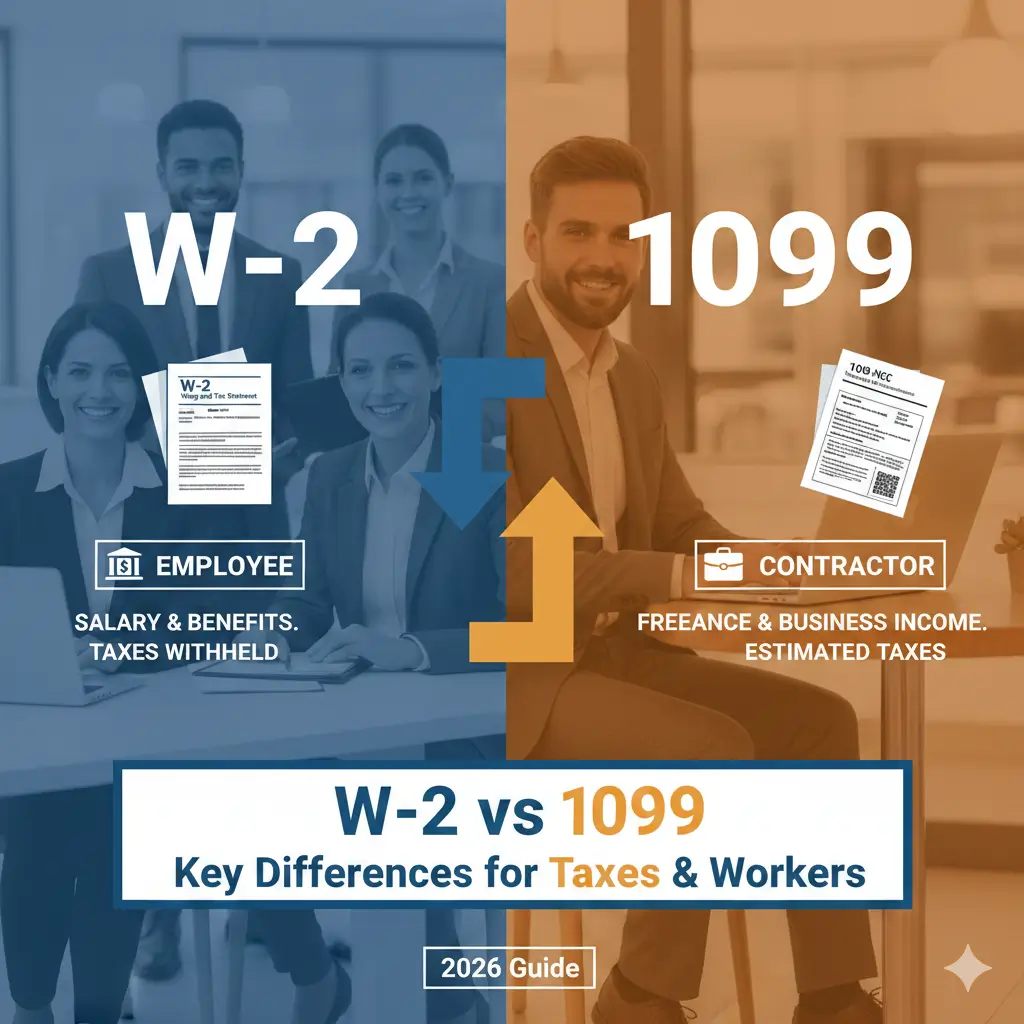
W-2 vs 1099
W-2 vs 1099: Key Differences for Taxes & Workers (2026 Guide)
If you’re looking at tax forms and wondering “Am I a W-2 employee or a 1099 contractor?”—you’re not alone. This distinction affects your taxes, benefits, and legal rights. This 2026 guide breaks down the key differences in plain English.
Quick Comparison Table
| Feature | W-2 Employee | 1099 Contractor (Self-Employed) |
|---|---|---|
| Tax Withholding | Employer withholds & pays taxes | You pay all taxes yourself |
| Tax Forms | Receive W-2 by Jan 31 | Receive 1099-NEC (or other) by Jan 31 |
| Benefits | May receive health insurance, 401(k), PTO | No employer-provided benefits |
| Control | Employer controls how, when, where work is done | You control how, when, where work is done |
| Expenses | Employer covers work expenses | You deduct business expenses on Schedule C |
| Payments | Regular paycheck (often bi-weekly) | Invoice payments (terms vary) |
| Legal Status | Protected by labor laws (minimum wage, overtime) | Fewer legal protections |
| Job Security | Typically more stable | Project-based, less secure |
Key Differences Explained
1. Tax Withholding Requirements
- W-2: Your employer automatically withholds:
- Federal & state income tax
- Social Security (6.2%) and Medicare (1.45%) taxes
- You file Form W-4 to adjust withholding
- 1099: You’re responsible for:
- Paying self-employment tax (15.3% total for Social Security + Medicare)
- Making quarterly estimated tax payments (if you owe $1,000+)
- Filing Schedule C with your tax return
2. Deduction Opportunities
- W-2 Employees: Limited deductions (unreimbursed work expenses generally not deductible)
- 1099 Contractors: Can deduct business expenses:
- Home office (simplified or regular method)
- Equipment, software, supplies
- Mileage (67¢ per mile in 2026)
- Marketing, professional fees
- Health insurance premiums (self-employed health insurance deduction)
3. Quarterly Estimated Payments (For 1099 Only)
If you’re 1099, you must pay taxes quarterly:
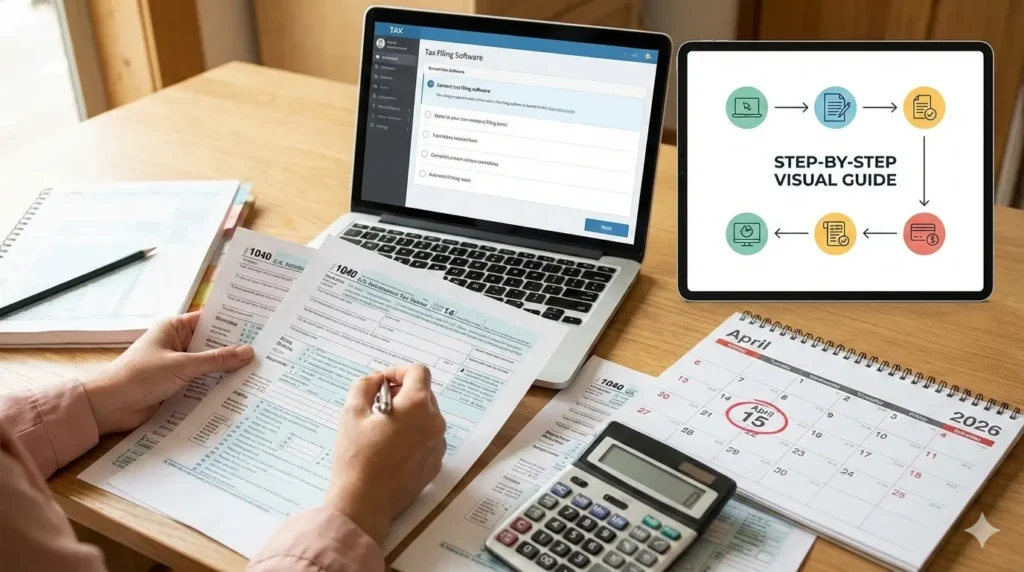
- Due Dates 2026: April 15, June 16, Sept 15, Jan 15 (2027)
- Penalty: Underpayment penalties if you don’t pay at least 90% of your tax liability
4. Legal Protections & Benefits
- W-2 Employees Protected By:
- Minimum wage laws
- Overtime pay (1.5x after 40 hours)
- Family Medical Leave Act (FMLA)
- Unemployment insurance
- Workers’ compensation
- Anti-discrimination laws
- 1099 Contractors: Generally not eligible for these protections
“Which One Are You?” Quick Checklist
Answer these questions to determine your likely status:
If you answer YES to most of these, you’re likely a W-2 employee:
- Does your employer control your work hours and location?
- Do they provide tools/equipment?
- Are you paid hourly or salary (not per project)?
- Do you receive benefits (health insurance, 401k)?
- Is there no end date to your work arrangement?
If you answer YES to most of these, you’re likely a 1099 contractor:
- Do you set your own hours and work location?
- Do you use your own equipment/tools?
- Are you paid per project/by invoice?
- Can you work for multiple clients simultaneously?
- Do you have a written contract specifying project scope?
- Are you responsible for your own taxes and insurance?
💡 Important: The IRS uses a 20-factor test focusing on behavioral control, financial control, and relationship type. Misclassification can lead to penalties for employers.
Tax Implications for Each (2026 Tax Year)
W-2 Employee Taxes
- Income: Reported in Box 1 of W-2
- Taxes Already Paid: Shown in Boxes 2 (federal), 17 (state)
- Filing: Use W-2 with Form 1040
- Typical Deductions: Standard deduction ($14,600 single in 2025), IRA contributions, student loan interest
- Tax Deadline: April 15, 2026
1099 Contractor Taxes
- Income: Sum of all 1099 forms (1099-NEC, 1099-MISC, etc.)
- Forms Needed:
- Schedule C: Report income and business expenses
- Schedule SE: Calculate self-employment tax
- Form 1040-ES: For estimated payments
- Additional Taxes: Self-employment tax (15.3% on net earnings)
- Quarterly Payments Required (see dates above)
- Retirement Options: SEP IRA, Solo 401(k) (higher limits than W-2)
Example Tax Comparison (Earning $60,000):
text
W-2 Employee:
- Take-home pay: ~$45,000-48,000 (after all taxes)

1099 Contractor:
- Must set aside ~$18,000 for taxes (30% rule)
- After business deductions, might pay less
What to Do If You Receive the Wrong Form
Situation 1: You’re treated as 1099 but should be W-2
- Talk to employer first (politely explain classification concerns)
- File Form SS-8 (Determination of Worker Status) with IRS
- File Form 8919 with tax return to pay only your share of taxes
- Contact state labor department if owed overtime/minimum wage
Situation 2: You’re treated as W-2 but should be 1099
- Re-negotiate contract to ensure proper classification
- Track business expenses you’re not being reimbursed for
- Consider forming an LLC for liability protection
Frequently Asked Questions
Q: Can I be both W-2 and 1099 in the same year?
A: Yes! Many people have a W-2 job and 1099 side gigs. Report all income on your tax return.
Q: Which is better financially?
A: It depends. 1099 offers more deductions but less stability. W-2 offers benefits but less control. Typically, 1099 rates should be 25-40% higher to account for taxes and benefits.
Q: How do I know if I’m misclassified?
A: Common signs: You work set hours at employer’s location using their equipment but receive a 1099. This is often illegal misclassification.
Q: What if my employer won’t give me a 1099?
A: You must still report the income! Track payments and report as “miscellaneous income” on Schedule C.
Next Steps & Resources
- Review your situation using the IRS’s Worker Classification Guide
- Track everything: Use apps like QuickBooks Self-Employed or spreadsheets
- Consult a tax professional if unsure about your status
- Read our related guides:
Disclaimer: This information is for educational purposes. Consult a qualified tax professional or employment attorney for advice specific to your situation.
⭐ Customer Ratings
4.5 out of 5 stars (based on 2 reviews)
📝 Leave Your Review
📌 All Customer Reviews
IiCScybNtqgwbvjY
September 9, 2026
8819398276
No Title
May 10, 2026
NOTE: As an Amazon Associate, We earn from qualifying purchases