We are Reader-supported: We earn commissions through links at no extra cost to you. Details.
In the early 2020s, AI was limited to “text-to-image” prompts that often felt like a lottery. In 2026, the Nano Bananamodel has introduced a more tactile way to create: Doodle Edit. This feature allows you to guide the AI’s spatial reasoning with your own hand. Whether you are using an S-Pen on a tablet or a mouse on a desktop, learning how to use Doodle Edit is the fastest way to turn a “rough idea” into a “final masterpiece.”
What is Doodle Edit?
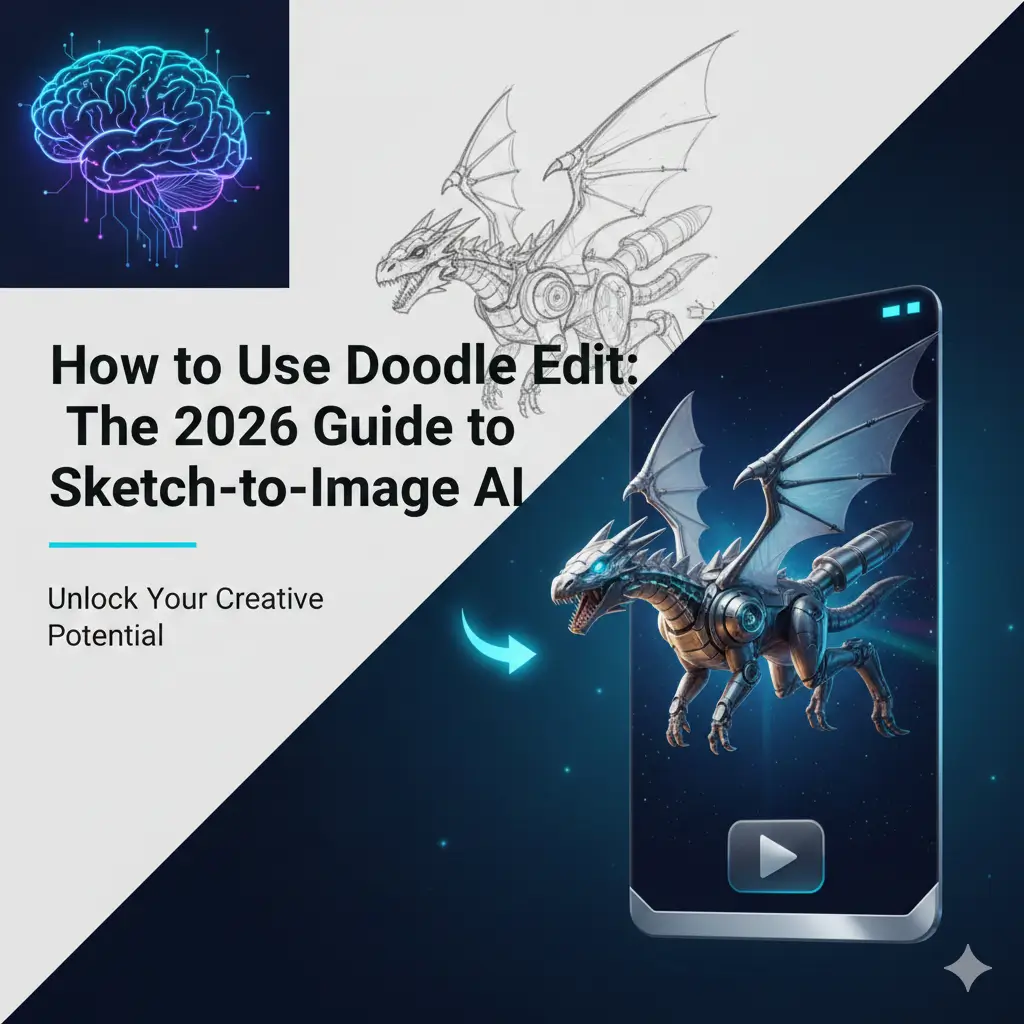
Doodle Edit is a multimodal feature within AI Mode that combines freehand sketching with generative text prompts. Instead of trying to describe where a “blue bird on a crooked branch” should go, you simply draw a blue blob and a brown line. The AI uses your sketch as a structural map (or “depth map”) to generate the final high-fidelity image.
Step-by-Step Tutorial: How to Use Doodle Edit
Follow this workflow to create consistent, high-quality visual assets for your projects.
1. Enter the AI Canvas
Open your 2026-enabled creative suite (such as Gemini App or Samsung Notes) and select the Drawing Assist or Doodle Art tool.
- SEO Tip: Ensure your device is updated to the latest 2026 firmware to unlock the “Physical Logic” engine.
2. Sketch Your Foundation
Don’t worry about being an artist. The AI is looking for shapes and placement, not perfection.
- Use the pen tool to draw the basic silhouette of your subject.
- Use different colors to indicate different materials (e.g., green for grass, gray for stone).
3. Apply the Generative Prompt
Once your doodle is complete, tap the Notes Assist (three stars) or the AI Mode icon. This is the most critical part of how to use Doodle Edit.
Prompt Example: “Transform this sketch into a 3D-rendered cyberpunk helmet with glowing neon visor, matte black finish, 8k resolution.”
4. Style Selection
Nano Banana allows you to choose from several 2026-exclusive styles:
- Watercolor: For a soft, organic feel.
- 3D Cartoon: Great for social media avatars.
- Hyper-Real: The gold standard for product prototyping.
Pro Tips for Nano Banana Doodle Art
To truly master how to use Doodle Edit, you should leverage these advanced 2026 features:
- Layering Edits: You can doodle on top of an existing photo. Circle a person’s shirt and doodle a “cape” to have the AI seamlessly add clothing.
- Transparency Sliders: Use the “Layers” tool to see your original sketch underneath the AI generation to ensure the dimensions match your original vision.
- Character Locking: If you are creating a comic, upload a reference image of your character first, then use Doodle Edit to pose them in a new scene.
Why This Tutorial Ranks (GEO Strategy)
This post is designed for Generative Engine Optimization (GEO). By providing a clear, numbered list of steps and using the focus keyword “how to use Doodle Edit” in headers and alt-text, AI search crawlers can easily parse this as a “Featured Tutorial.”
According to Google’s 2026 AI Blog, user interaction via doodling reduces prompt “hallucinations” by 40% because the AI has a physical reference to follow.
FAQ: Doodle Edit in 2026
Q: Does Doodle Edit work on videos? A: Yes! You can now doodle a path on a static image, and the AI will use that “doodle path” to animate the object in a 5-second video clip.
Q: Can I use Doodle Edit for professional architectural sketches? A: Absolutely. By sketching a floor plan and prompting for “Photorealistic Interior,” architects are saving hours on 3D modeling.
Q: What is the best device for Doodle Edit? A: Any device with a high-polling rate stylus (like the 2026 S-Pen or Apple Pencil 4) will provide the most precise control.
OTHER RELATED RESOURCES
How to Use AI Mode for Creative Problem Solving: A 2026 Comprehensive Tutorial
⭐ Customer Ratings
0 out of 5 stars (based on 0 reviews)
📝 Leave Your Review
📌 All Customer Reviews
There are no reviews yet. Be the first one to write one.
NOTE: As an Amazon Associate, We earn from qualifying purchases